Important Safety Note: If you ever notice sparks, burning smells, or loose outlets in your home, stop using them immediately and contact a licensed electrician to prevent electrical hazards.
Why Are Some Electrical Outlets Installed Upside Down?
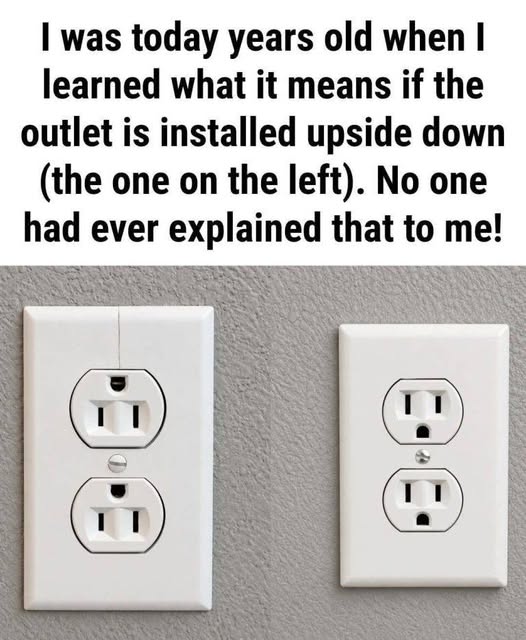
Many people assume outlets with the grounding hole at the top are installed incorrectly. In reality, this orientation is often a deliberate safety choice made by electricians in specific settings.
Understanding the orientation of electrical outlets can help you recognize intentional safety measures and differentiate them from installation errors.
Safety Considerations: Grounding Hole on Top
Imagine a plug that is not fully inserted into an outlet. If a conductive object—like a metal tool, jewelry, or paperclip—falls between the plug and the outlet, it could contact energized prongs, creating a risk of shock or short circuit.
When the grounding hole is positioned at the top, the grounded pin connects first. If a metal object slides down, it is more likely to touch the grounded pin rather than the live electrical contacts. This reduces the chance of accidental electrical shorts and enhances safety.
This precaution is especially valued in environments where safety is critical, such as hospitals and commercial buildings.
Where Are Upside-Down Outlets Most Common?
Hospitals frequently install outlets with the grounding pin facing upward. Medical equipment is plugged and unplugged frequently, and patient safety depends on minimizing electrical hazards. The ground-up orientation helps reduce the risk of conductive objects bridging live prongs if plugs become partially disconnected.
Similarly, many commercial buildings, including offices, laboratories, schools, and industrial facilities, use this orientation. Electricians often follow engineering specifications that call for consistent ground-up outlet installation to improve safety, simplify circuit identification, and comply with project requirements.
Is Upside-Down Outlet Installation Required by Electrical Code?
Contrary to common belief, there is generally no universal electrical code mandating that outlets be installed only with the grounding hole on top or bottom. Local codes usually allow either orientation as long as the installation is safe and compliant with regulations.
This means electricians may install outlets with the grounding pin on top, bottom, or even sideways, depending on the installation context and local requirements.
Why Are Most Residential Outlets Installed Ground-Down?
The predominant ground-down orientation in homes is largely due to tradition and familiarity. Residential construction has historically favored this standard, and manufacturers and furniture designers expect outlets to be oriented this way.
Over time, this became the visual norm, making ground-down outlets appear as the “correct” orientation even when alternatives offer safety advantages.
Check Your Medicine Cabinet of Electrical Safety: Grounding Pins Matter
The grounding pin provides a critical safety path for electrical faults. It connects metal parts of appliances to the earth ground, preventing exposed surfaces from becoming energized and reducing shock risk.
It is important never to remove the grounding pin from plugs to fit older two-prong outlets. If your home has ungrounded outlets, consult a qualified electrician to evaluate and upgrade them safely.
Partial plug insertion can create hazards if the grounding pin is not engaged first. The ground-up outlet orientation helps mitigate this risk by ensuring the grounding connection is the first to make contact.
Understanding these details empowers you to recognize safe electrical installations and avoid unsafe modifications.
Here are the 10 key topics that explain outlet orientation and safety. Number 1 reveals the main safety reason electricians choose to install outlets upside down.