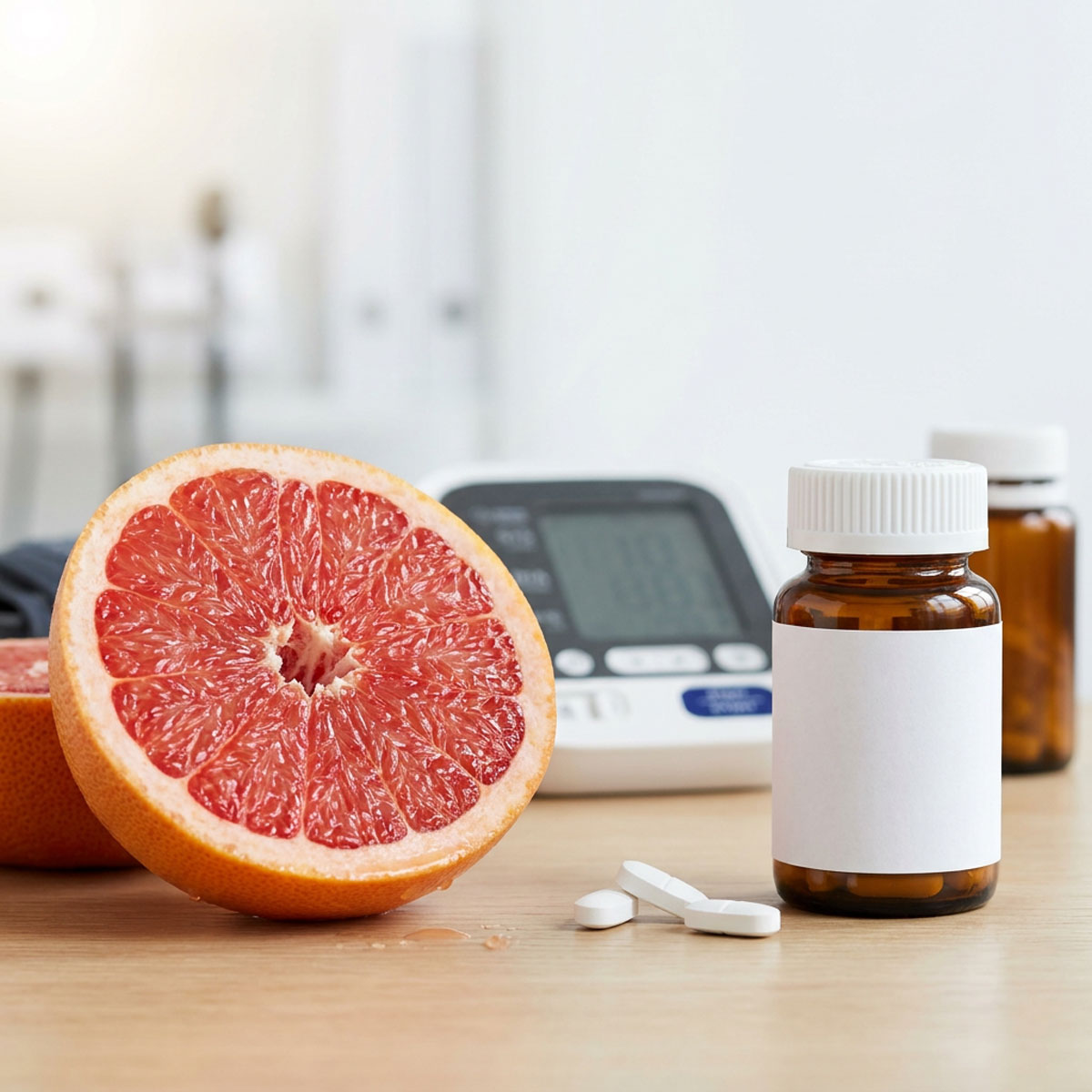
If you experience unusual muscle pain, dizziness, bruising, or irregular heartbeat, seek medical attention promptly.
Why Grapefruit Can Change How Your Medication Works
Grapefruit is widely recognized for its health benefits, especially as a vitamin C-rich fruit often included in heart-healthy diets. However, it stands apart from most foods because it can significantly alter how certain prescription medications behave inside your body.
This effect is not common to all medications, nor does it make grapefruit inherently dangerous. Instead, the interaction depends on the specific drug you are taking and how grapefruit’s natural compounds affect your body’s drug-processing enzymes.
The Key: Grapefruit’s Impact on Drug Metabolism
Many medications are metabolized in the small intestine by an enzyme called CYP3A4, which acts like a filter, breaking down a portion of the drug before it enters your bloodstream. Grapefruit contains compounds that temporarily inhibit this enzyme, reducing its filtering action.
As a result, more of the drug may enter your bloodstream than intended, enhancing the medication’s effects and potentially increasing side effects. Contrary to common assumptions, grapefruit interaction often makes a medicine stronger—not weaker.
Not All Interactions Increase Medication Effects
For some medications, grapefruit affects different intestinal transport systems that help absorb the drug. In these cases, grapefruit can reduce the amount of medicine absorbed, weakening its effect.
This dual possibility—either increasing or decreasing drug levels—makes it essential to know exactly which medication you are taking rather than relying on broad categories.
Timing Grapefruit and Medication Doesn’t Always Help
A common question is whether spacing grapefruit consumption and medication dosing prevents interactions. Unfortunately, the enzyme inhibition caused by grapefruit lasts longer than the fruit remains in your digestive tract, so separating the timing usually does not eliminate the interaction.
Therefore, pharmacists generally advise evaluating whether grapefruit and your specific medication are compatible rather than trying to adjust timing.
Check Your Medicine Cabinet
Many people take multiple medications, and not all are affected by grapefruit. Some drugs within the same family behave differently. For example, among cholesterol-lowering statins, simvastatin and atorvastatin are affected, but pravastatin is not. This makes it vital to identify the exact medication name.
Before making any changes to your diet or medication, consult your pharmacist or healthcare provider. They can quickly review your prescriptions and advise whether grapefruit consumption is safe with your medications.
Here are the 10 most critical medication interactions with grapefruit. Number 5 is the one most people assume is safe but actually requires caution.